Powering the Cold Chain: The Infrastructure Bet That Could Transform Africa's Food Economy
Africa's food economy does not only need more production. It needs the infrastructure to preserve value between farm and market, and distributed cold-chain investment could become one of its most consequential growth platforms.
Three signals for decision-makers
Preserve value
Move cooling closer to production before quality and income are lost.
Connect the chain
Combine storage, transport, monitoring and market access as one system.
Finance operations
Fund utilisation and maintenance alongside the physical equipment.
The value lost between harvest and market
A crop can be successfully grown and still fail to become income. The weak point is often the journey after harvest: limited cooling, unreliable power, fragmented transport and too little visibility across the supply chain.
Cold-chain infrastructure addresses that gap by protecting quality while food moves from producer to aggregator, processor, retailer and consumer. The result is not simply less waste; it is a stronger commercial proposition for everyone connected to the product.
Infrastructure at the point of need
Large central facilities matter, but many producers operate far from dependable power and established logistics corridors. Distributed cold rooms positioned near production zones can shorten the distance between harvest and preservation.
Solar generation and efficient storage systems make that model more practical in locations where grid power is costly or inconsistent. The design challenge is to match capacity to local crop cycles, aggregation patterns and realistic demand rather than installing infrastructure in isolation.
Commercial intelligenceCold-chain investment preserves more than food. It preserves income, market access and the value created at the farm.
A connected chain, not a collection of assets
A cold room cannot transform a food system on its own. Its value depends on transport schedules, pack-house processes, temperature discipline, market access and the information shared between participants.
Digital monitoring can help operators track conditions, manage capacity and identify breaks before products lose value. When that visibility is shared responsibly, lenders, insurers, buyers and producers can make decisions with greater confidence.
Financing the missing middle
Cold-chain projects sit between infrastructure and operating business. They require patient capital for equipment, but their long-term viability depends on utilisation, maintenance and reliable local management.
Blended finance, anchor customers and service-based models can distribute risk more effectively than asking small producers to carry the full cost. Investors should evaluate the complete commercial system: who supplies volume, who pays for cooling, who maintains the equipment and which market rewards preserved quality.
From food security to export capability
A reliable cold chain can expand the range of markets available to African producers. Better preservation supports longer selling windows, stronger quality control and the consistency required by processors, hospitality businesses and export buyers.
The opportunity is therefore wider than loss reduction. Cold infrastructure can connect rural production to higher-value demand, strengthen local food resilience and create a platform for new logistics, finance and data services around the food economy.
Leadership agenda
What to do next
- Map crop flows and buyer demand before selecting infrastructure locations.
- Design power, storage and transport as a connected operating system.
- Build maintenance and local technical capacity into the financing model.
- Use temperature and utilisation data to improve confidence across the chain.
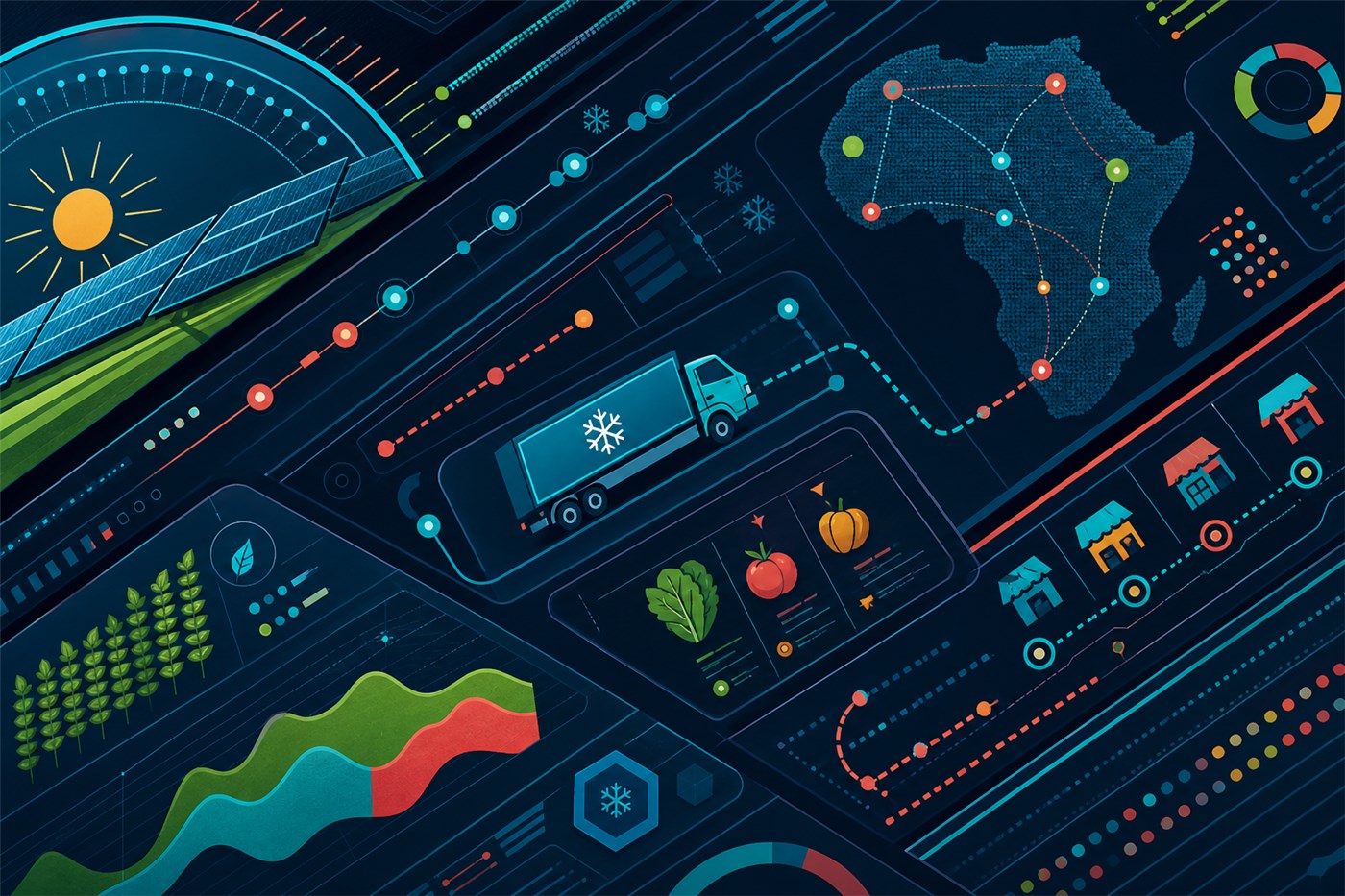
Distributed energy, refrigerated logistics and market connectivity can help preserve value across Africa's food supply chains.